
About the Journal
The journal Gestión en Salud y Seguridad Social is the official scientific publication of the Costa Rican Social Security Fund (CCSS). This aims to provide decision-makers and professionals in the health sector with inputs that allow modifying, strengthening or creating new processes of care, management and administration, for the benefit of the population.
It includes health and social security issues, such as: management and administration, policies and legislation, care management, technology, economics, equity and the right to health, pensions, epidemiology, primary health care, occupational health, environmental health, community and social participation, health promotion and education, social sciences, project evaluation, among others.
Editorial Ethics Policy
The journal is committed to the highest ethical standards in scientific publishing. This policy applies to all parties involved in the editorial process: authors, reviewers, editors, and the editorial team. Compliance with them is essential to ensure the integrity, transparency and credibility of published content.
1. Authors' commitments
- Authors must guarantee that the manuscript is original, unpublished and has not been simultaneously submitted to another journal.
- Any form of plagiarism, self-plagiarism, manipulation of data or falsification will be considered a serious offense.
- Third-party sources and contributions should be properly acknowledged.
- All authors must have contributed significantly to the work and approve the final version of the manuscript.
- Any conflicts of interest or funding that may influence the results must be declared.
2. Reviewers' commitments
- Reviewers must make an objective, confidential and substantiated evaluation of the manuscript.
- They should refrain from reviewing whether there is a conflict of interest with the authors or the content.
- They must not use the information contained in the manuscript for personal or professional gain.
- They are expected to deliver their opinions within the established deadlines.
3. Commitments of the Editorial Committee
- The editorial team is responsible for the final decision on the publication of manuscripts.
- It must ensure a fair, impartial, and confidential review process.
- It undertakes to act diligently in the event of any complaint of scientific misconduct, following the protocols established by COPE.
- In case of errors, retractions or corrections, the journal will act with transparency and promptness.
4. Misconduct Prevention
- The journal uses similarity detection tools to prevent plagiarism.
- Any suspicion of misconduct will be seriously investigated and, if necessary, corrective action will be taken, including retraction of the article.
Human rights and ethics in research
- Studies involving humans or animals must be approved by an institutional ethics committee and comply with international regulations.
- An ethical statement should be included in the manuscript, as well as informed consent from participants, where applicable.
Plagiarism Policy
The journal maintains a zero-tolerance policy against plagiarism, in all its
forms, as part of its commitment to academic integrity and ethics in scientific
publishing.
- Definition of plagiarism
Plagiarism is considered to be the total or partial presentation of ideas, data, images,
texts or results of other authors as one's own, without due attribution. This
includes, but is not limited to:
- Copying fragments of published works without citing the source.
- Paraphrasing content without proper recognition.
- Reuse previously published own works (self-plagiarism) without explicitly indicating it
- Present as original results obtained by third parties.
- Plagiarism detection
All manuscripts received are subjected to a similarity detection process using specialized tools (for example, Turnitin, iThenticate or other recognized platforms). The Editorial Committee will evaluate the reports generated and determine if there is an ethical violation. - Consequences of plagiarism
In the event of plagiarism being detected, the journal may apply one or more of the
following measures, depending on the seriousness of the case:
- Immediate rejection of the manuscript.
- Notification to authors and their affiliated institutions.
- Temporary or permanent prohibition of submitting new manuscripts to the journal.
- Public retraction of the article, if it has already been published.
- Responsibility of the authors
Authors are responsible for ensuring the originality of their work and for correctly citing all sources used. By submitting a manuscript, authors declare that the content is original and does not infringe the rights of third parties. - Education and prevention
The journal promotes the ethical training of authors, reviewers, and editors, and encourages the responsible use of sources and correct citation as part of a culture of academic integrity.
Open Science Policy
In accordance with the international principles of open science and with the aim of promoting a more transparent, accessible and reproducible scientific communication, this journal adopts the following guidelines:
- Immediate
open access All articles accepted for publication will be immediately available in open access, under a Creative Commons license (CC BY-NC-SA), guaranteeing free access to the content without economic, technical or legal restrictions. - Transparency in the peer
review process The openness of the peer review process is promoted through the possibility of publishing evaluation reports, reviewers' names (where relevant) and previous versions of the manuscript. This practice seeks to strengthen the integrity and traceability of the editorial process. - Use of preprints
Authors are encouraged to deposit preliminary versions of their manuscripts on recognized preprint servers, as part of the flow of scholarly communication and in compliance with the principles of early dissemination of knowledge. - Management and availability of research
data Authors should include an explicit statement about the availability of the data underlying the results presented. The deposit of datasets, source codes, protocols, and other complementary materials in open, trusted, and persistently identifier repositories is encouraged. - Interoperability and technical
standards Manuscripts must comply with international metadata and interoperability standards (e.g., XML JATS), facilitating their indexing, preservation, and visibility in databases and scientific information systems. - Interoperability and access to metadata (OAI-PMH)
The journal Gestión en Salud y Seguridad Social exposes its metadata through the OAI-PMH protocol (Open Archives Initiative Protocol for Metadata Harvesting), thus guaranteeing interoperability with repositories and indexing systems. In this way, published articles can be collected and disseminated on academic platforms and specialized search engines, increasing their visibility and access.
The OAI-PMH protocol link is:
https://www.binasss.sa.cr/ojssalud/index.php/gestion/oai - Persistent identification of authors and contributions
It is mandatory that all authors be registered with an ORCID identifier. A detailed statement of each author's individual contributions is also required. - Editorial ethics and good practices
The journal adheres to international ethical standards in scientific publishing, including the declaration of conflicts of interest, the registration of clinical trials (when applicable), and the implementation of mechanisms for the correction, retraction or clarification of contents. - Linguistic and geographical diversity
Publication in multiple languages and the participation of authors, reviewers, and editors from diverse geographic regions, disciplines, and institutional contexts are encouraged, for the sake of a more inclusive and representative science. - Digital preservation and global
dissemination The journal guarantees the digital preservation of its contents through reliable archiving systems and its dissemination through international platforms, ensuring its long-term availability and global impact. Specifically, a copy backup of all files is used, in different formats, and both copies and formats are updated annually.
The Journal of Health and Social Security Management uses the Creative Commons Attribution-NonCommercial-ShareAlike (CC BY-NC-SA) license, which allows the reader to:
- Share — copy and redistribute material in any medium or format.
- Adapt — remix, transform and build from the material.
All this free of charge, provided that the following conditions are met:
- Attribution (BY): Proper credit must be given, a link to the license must be provided, and any changes have been made. This may be done in a reasonable manner, but not in a way that suggests that the licensor endorses the use.
- Non-Commercial (NC): The material may not be used for commercial purposes.
- Share Alike (SA): If the material is remixed, transformed, or created, the contribution must be distributed under the same license as the original.
You can consult the complete description and legal text of this license at the following official Creative Commons link:
https://creativecommons.org/licenses/by-nc-sa/4.0/deed.es
Statement of peer review in the framework of open science
In accordance with the principles of open science, this journal promotes editorial practices that favor transparency, traceability and collaboration in the scientific evaluation process. In this sense, peer review is a fundamental pillar to guarantee the quality and integrity of the content published.
- Evaluation
modality
The journal Gestión en Salud y Seguridad Social generally uses the double-blind peer review system, in which the identity of both authors and reviewers is safeguarded. However, the possibility of applying the single-blind review modality is contemplated, in the case of preprints.
Double-blind peer reviewIn this modality,
the personal data of the evaluators and
authors are reserved, in order to avoid conflicts between the parties. This process consists of several
stages, which are detailed below.
Single-blind Preprint
Evaluation
In the evaluation of preprints under the single-blind review scheme, the reviewer knows the identity of the author, but the author does not know the identity of the reviewer. The objective of this model is to strengthen the quality, methodological rigor and transparency of manuscripts disseminated as preprints before or in parallel to their formal submission to the journal Gestión en Salud y Seguridad Social. This process consists of several stages, which are detailed below.
- Recognition of the review
workThe journal recognizes the academic value of the work of the reviewers. In cases where open review is implemented, a persistent identifier (DOI) may be assigned to the evaluation reports, allowing their citation and visibility in the academic field. - Ethics and confidentiality
Regardless of the modality adopted, the journal guarantees compliance with ethical principles in the evaluation, including confidentiality, impartiality, the absence of conflicts of interest and mutual respect between authors and reviewers. - Transparency and continuous
improvementThe opening of the review process seeks to strengthen trust in scientific evaluation, encourage academic dialogue and contribute to the continuous improvement of manuscripts. The journal is committed to regularly reviewing and updating its editorial policies, in order to align with international best practices in open science.
Manuscript review process
The journal establishes a rigorous and transparent editorial process for evaluating submitted manuscripts, with the aim of ensuring the scientific quality, originality, and relevance of the published content.
Double-Blind Peer Review
Stages of the Process
- Receipt and Initial Editorial Review
Once the manuscript is received, the journal's editorial team conducts a preliminary review to verify:
- Compliance with formal requirements (as specified in the Instructions for Authors).
- Suitability of the topic within the journal’s editorial scope.
- Originality of the content, ensuring there are no issues related to plagiarism or duplicate publication.
- Properly designed and applied methodology.
- Quality of writing (clear, understandable, and logically structured).
The purpose of this review is to anticipate observations that reviewers may raise and strengthen the manuscript before the peer-review process.
Authors are strongly encouraged to carefully review all these aspects before submission. If the article is found to have serious deficiencies in one or more of these areas, it will be rejected.
This process may take approximately one month.
- Assignment of Reviewers
If the manuscript passes the initial review, one or two reviewers with subject-matter and methodological expertise are selected. Reviewers are chosen based on academic competence, impartiality, and the absence of conflicts of interest.
- Peer Review
The evaluation is conducted through a peer-review system in which two experts in the subject matter read and analyze the manuscript to determine its quality and validity.
Within one month, the selected specialists assess the article according to the following criteria:
- Importance
b. Originality
c. Timeliness
d. Coherence
e. Reliability of Information
f. Title–Content Relationship
g. Analysis of the Methodology Used
As a result of this process, reviewers issue one of the following recommendations:
- Publication recommended.
- Publication recommended subject to revisions.
- Publication pending (the document requires substantial revision).
- Do not publish.
Once completed, the article and evaluation reports are sent to the editor. In the event of disagreement between reviewers, a third evaluation may be requested to break the tie. This process may take an additional three weeks.
- Editorial Decision
Based on the reviewers’ reports, the Editorial Committee issues a decision:
- Accept without changes.
- Accept with minor revisions.
- Major revisions and re-evaluation.
- Reject.
If publication is accepted but revisions are required, the manuscript is returned to the authors so that they may incorporate the observations and recommendations within 15 to 22 days.
If the Editorial Committee decides not to publish the article, the authors will be informed along with the corresponding justification.
The final decision regarding acceptance or rejection of the manuscript always rests with the Editorial Committee.
- Author Revisions
If revisions are requested, authors must submit a revised version of the manuscript within the specified deadline.
- Final Editorial Decision
Once authors submit the corrected manuscript, the editor verifies the revisions and, in cases of major changes, the reviewers may also be consulted.
If the manuscript still does not meet the required corrections and quality standards, it will be returned to the authors as many times as necessary until it complies with the requested criteria. These additional rounds may significantly delay publication; therefore, authors are strongly encouraged to address all comments thoroughly in the first revision.
- Editing and Publication
Once the manuscript is accepted, copyediting is performed, focusing mainly on writing style, spelling, citations, and references. Authors review the final version and provide their approval. Subsequently, layout design, proof review, and typesetting are carried out.
The article is then published online in open access, with its corresponding DOI and metadata.
- Timeline of the Manuscript Review Process
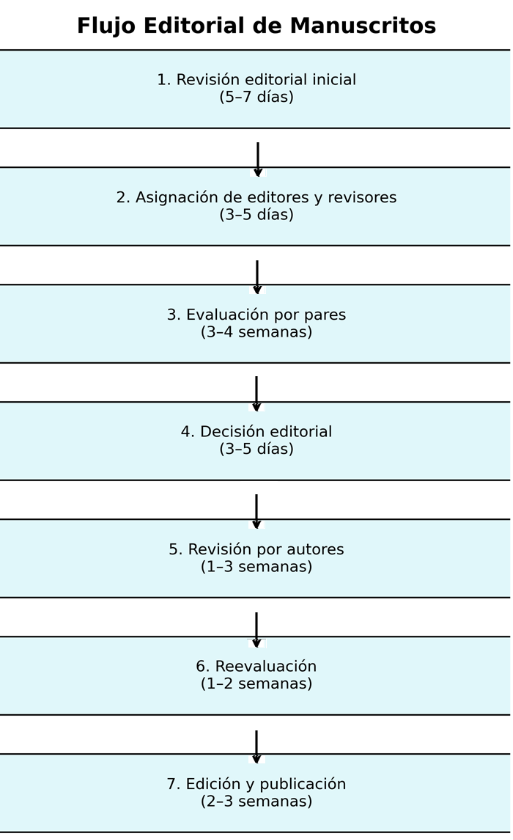
Overall, the period from submission to acceptance is approximately four months.
For questions regarding this process, please contact: ednasss@binasss.sa.cr or iramirez@binasss.sa.cr.
Single-Blind Review
Stages of the Process
- Receipt of the Preprint and Initial Editorial Review
Once the preprint is received, the journal’s editorial team conducts a preliminary review to verify minimum requirements, including format, file completeness, language, metadata, and ethical declarations. In addition, compliance with good research practices is assessed (informed consent, ethics committee approval, clinical trial registration when applicable, among others).
This process may take approximately one month.
- Assignment of Reviewers
After the first stage has been completed, one or two reviewers with subject-matter and methodological expertise are selected.
Since, in this model, reviewers know the identity of the authors, conflict-of-interest disclosure and management are required, as described below:
Conflict of Interest Declaration
Each reviewer must disclose any personal, professional, financial, or academic relationship with any of the authors or with the content of the preprint that could affect their impartiality. Examples include working with one of the authors, maintaining an academic rivalry, or having financial interests related to the topic.
Conflict of Interest Management
Once a conflict has been declared, the Editorial Committee must assess whether it is significant. If so, the individual may not serve as a reviewer, and another reviewer must be appointed to ensure objectivity. In less significant cases, transparency measures may be applied, such as recording the declaration in the system.
This entire process is estimated to take approximately one month.
- Peer Review
The evaluation is conducted through a peer-review system in which one or two expert reviewers read and analyze the manuscript to determine its quality and validity.
Within one month, reviewers assess the article according to the following criteria:
- Importance
b. Originality
c. Timeliness
d. Coherence
e. Reliability of Information
f. Title–Content Relationship
g. Analysis of the Methodology Used
As a result of this process, reviewers issue one of the following recommendations:
- Publication recommended.
- Publication recommended subject to revisions.
- Publication pending (the document requires substantial revision).
- Do not publish.
Afterward, the article and review reports are sent to the editor. If conflicting recommendations arise, a third review may be requested. This process may take an additional three weeks.
- Editorial Decision
Based on the reviewers’ reports, the Editorial Committee issues a decision:
- Accept without changes.
- Accept with minor revisions.
- Major revisions and re-evaluation.
- Reject.
If publication is accepted but revisions are required, the manuscript is returned to the authors so that they may incorporate the observations and recommendations within 15 to 22 days.
If the Editorial Committee decides not to publish the article, the authors will be informed along with the corresponding justification.
The final decision regarding acceptance or rejection of the manuscript always rests with the Editorial Committee.
- Author Revisions
If revisions are requested, authors must submit a revised version of the manuscript within the specified deadline.
- Final Editorial Decision
When authors submit the corrected manuscript, the revisions are verified by the editor and, in cases involving major changes, by the reviewers.
If the manuscript still does not meet the required corrections and quality standards, it will be returned to the authors as many times as necessary until it satisfies the requested criteria. These additional rounds may significantly delay publication; therefore, authors are strongly encouraged to address all comments thoroughly in the first revision.
Once accepted, the version and acceptance date are recorded; if updates are made, the version history is maintained.
- Good Practices
Throughout these stages, compliance with the following editorial principles is ensured:
- Data Policy: Promote the availability of datasets and supplementary materials through persistent links.
- Transparency: Describe limitations and disclose funding sources and conflicts of interest.
- Integrity: Use plagiarism-detection software and verify images/tables where applicable.
- Ethics: Protect sensitive information and safeguard identities when required by the field.
- Diagram of the Single-Blind Preprint Review Process
For questions regarding this process, please contact: ednasss@binasss.sa.cr or iramirez@binasss.sa.cr.